Orevian Pest SolutionsOrevian Pest Solutions

Carpenter Ant Remediation Springfield

Black carpenter ants (Camponotus pennsylvanicus) excavate wood galleries rather than consuming timber, leaving behind distinctive piles of coarse sawdust mixed with insect body fragments, known as frass. In older…
Get My Free Estimate →(413) 603-9164
Carpenter Ant Remediation in Springfield, MA
Quick answer
  • Scope: Comprehensive inspection of sill plates, wall voids, and damp subfloors, followed by non-repellent liquid perimeter applications and targeted nest micro-injections.
  • Turnaround: On-site inspections and targeted remediation procedures take between 90 minutes and 3 hours, with routine service available within 24 to 48 hours.
  • Investment: Initial remedial services start at a $250 minimum, with complete multi-nest structural treatments typically ranging from $350 to $750 based on square footage.
  • Target Pests: Remediation strictly targets wood-excavating black carpenter ants (Camponotus pennsylvanicus) along with secondary satellite colonies nesting in adjacent foam insulation or deck framing.
  • Dispatch: On-site evaluations are arranged by calling (413) 603-9164 or submitting photographs of observed frass and structural galleries for direct triage.

Black carpenter ants (Camponotus pennsylvanicus) excavate wood galleries rather than consuming timber, leaving behind distinctive piles of coarse sawdust mixed with insect body fragments, known as frass. In older Springfield housing stock across McKnight, Forest Park, and Liberty Heights, late-nineteenth-century balloon framing and settled sill plates frequently absorb rainwater or plumbing condensation, creating prime nesting conditions. Satellite colonies establish themselves inside hollow door cores, wall cavities near leaking dishwashers, or insulated roof eaves, while the parent colony remains outside in decaying tree stumps or old landscape ties. Single-story ranches in East Forest Park and Pine Point experience similar nesting in ground-contact porch supports and framing adjacent to shaded gutters.

Remediation uses scientific Integrated Pest Management (IPM) rather than broad-spectrum repellent sprays. Standard retail surface sprays scatter foraging workers, causing a colony to bud into multiple hidden sub-colonies throughout adjacent walls. Professional protocols introduce non-repellent liquid treatments containing active ingredients such as fipronil along structural entry thresholds, paired with specialized abamectin or indoxacarb gel baits. Foragers cross these invisible residue zones without alarm, transferring the compound back into the deep gallery network to neutralize the egg-laying queen within 14 to 30 days.

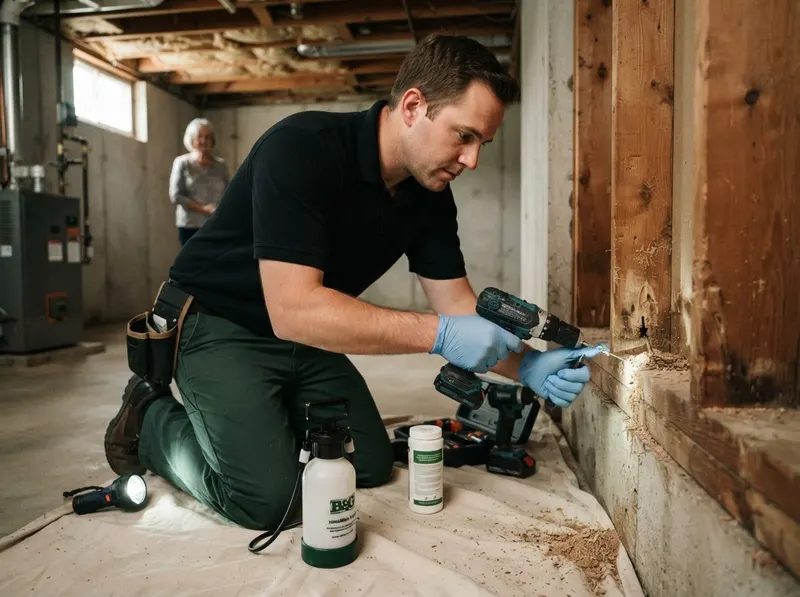
Selecting localized spot treatments suits isolated satellite colonies inside accessible porch framing, but full structural protection is required when winged swarmers emerge inside interior living areas. Winged reproductives indicate an established primary or secondary nest that has matured for over three years inside the framing envelope. Orevian Pest Solutions performs exterior perimeter banding around foundations and drills precise 1/8-inch access points into identified wall voids for targeted aerosolized dust applications, avoiding broad wall removal. The trade-off between exterior perimeter barriers and internal void injections hinges on nest location: treating only the outdoor foundation leaves interior queens unaffected, while treating only indoor voids allows outdoor parent colonies to continuously restock indoor satellite outposts.

Carpenter Ant Remediation cost in Springfield

Targeted Interior Void Injection (Single Room)$250, $375
Standard Exterior Barrier & Perimeter Remediation (Under 2,000 sq ft)$350, $525
Comprehensive Multi-Nest Remediation (Historic Balloon-Frame / Over 2,500 sq ft)$550, $750
Annual Preventative Exterior Perimeter Defense Renewal$250, $350

Every job gets a firm, written price after a free on-site visit.

Common questions

How does carpenter ant remediation in Springfield prevent structural collapse?
Remediation stops progressive timber degradation by neutralizing the queen and workers before their gallery networks hollow out load-bearing wall studs, joists, and foundation sill plates. Unlike termites, carpenter ants excavate clean, smooth channels in damp wood without leaving mud tubes, meaning prompt extraction preserves existing timber stability without requiring structural rebuilds if caught early.
Are carpenter ant eradication treatments safe for children and indoor pets in Springfield?
Exterior foundation bands and targeted interior void treatments utilize products registered by the EPA and applied according to strict label directions, keeping wet residues away from contact surfaces. Wall-void dust applications occur behind enclosed baseboards and drywall, eliminating family or pet exposure, and interior applications dry fully within 2 to 4 hours without requiring multi-day home evacuations.
Why do carpenter ants frequently invade homes in the McKnight and Forest Park neighborhoods?
Historic properties in McKnight and Forest Park often feature mature shade trees, dense tree canopies touching roof eaves, and aging wood porches with natural settling that allows rainwater seepage. These conditions supply the constant moisture and dead-wood proximity necessary to sustain outdoor parent colonies, which use utility lines and overhanging branches as bridges into structural soffits.
Is an expensive recurring monthly contract mandatory for carpenter ant treatment in Springfield?
Monthly recurring contracts are not required to eliminate an active carpenter ant infestation. Professional IPM protocols resolve active nesting using a one-time targeted treatment sequence with a 30-to-60-day biological cycle evaluation, allowing property owners to select standalone curative services starting at our $250 minimum without ongoing subscription fees.
What distinguishes carpenter ant frass from termite frass during a Springfield home inspection?
Carpenter ant frass resembles irregular pencil shavings accompanied by dead ant fragments and shredded debris, ejected directly from pinpoint openings called kick-out holes. Subterranean termites leave no loose exterior sawdust piles, producing soil-lined mud tubes instead, while drywood termites deposit microscopic, hard, six-sided oval pellets with rounded ends.
Helpful resources

Trusted references & local links

USA.gov, government & consumer helpBetter Business BureauFTC Consumer AdviceU.S. Small Business AdministrationReady.govU.S. EPAENERGY STARU.S. Dept. of EnergyConsumer.govU.S. Census BureauGoogle Maps, Springfield, MA

Get started today

Tell us about your carpenter ant remediation job in Springfield and we'll send a clear, written quote, usually the same day.

Get your free PEST CONTROL SEVICE quote, Springfield

We only use your ZIP to check availability, no spam.